AgentCore
The Problem
Every LLM provider ships its own SDK, message format, and streaming API, so switching models, or falling back to a second provider when one is rate-limited, usually means rewriting the integration layer.
Architecture & Topology
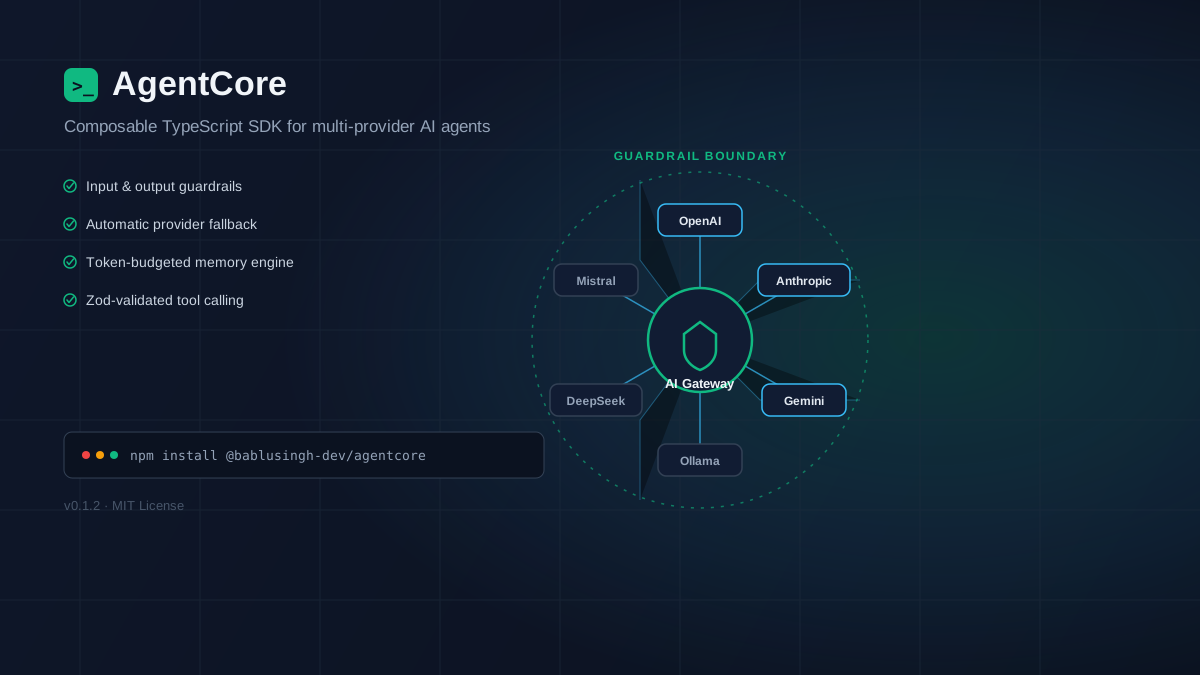
A TypeScript SDK with decoupled primitives: universal model adapters normalize OpenAI, Anthropic, Gemini, Ollama, DeepSeek, Mistral, and Grok into one request/response shape, sitting behind an AI gateway that handles routing, retries, and fallback. A memory engine manages context windows (sliding window, token budget, summary) with pluggable persistence and Mem0/vector adapters, and a guardrails layer validates schemas and filters input/output before anything reaches a tool or the caller.
Engineering Challenges
Normalizing streaming responses across providers that do not agree on chunk shape or even what counts as a tool-call event, while keeping the public API small enough that swapping providers is genuinely a one-line change.
Applied Solutions
Built a standardized adapter interface each provider implements, a token-budget-aware memory manager that summarizes or trims history before it silently exceeds a context window, and a guardrails engine that runs the same policy checks regardless of which model produced the output.
Results & Benchmarks
Published as @bablusingh-dev/agentcore on npm with a live docs site and interactive pipeline simulator at agentcore.bablusingh.in.
Performance Tuning
Gateway-level fallback and rate limiting so one slow or rate-limited provider does not take the whole pipeline down; memory strategies keep prompt size, and therefore per-request cost and latency, predictable.
Lessons Learned
Most of the real engineering in an agent framework is not the model call itself, it is what happens before and after it: validating what goes in, deciding what history survives the context window, and catching a malformed tool call before it reaches your code.